Growing Curious Minds: A Guide to STEM Schools and Learning in the Triangle
From engineering and robotics to computer science, creative design, and hands-on discovery, families in Cary and the greater Triangle have some exciting educational options to explore.
The Triangle has long been associated with research, technology, and innovation. With Research Triangle Park, NC State University, and a thriving network of technology and life-sciences companies nearby, it is perhaps fitting that families here have access to a growing range of educational opportunities designed to nurture the next generation of curious thinkers and problem-solvers.
For parents beginning to explore kindergarten or elementary school options, the choices can be a little overwhelming. STEM education is not a single curriculum or teaching philosophy. Some schools emphasize engineering and building. Others focus on computer science, coding, and digital design. Still others approach science and mathematics through hands-on exploration, collaborative projects, and interdisciplinary learning.
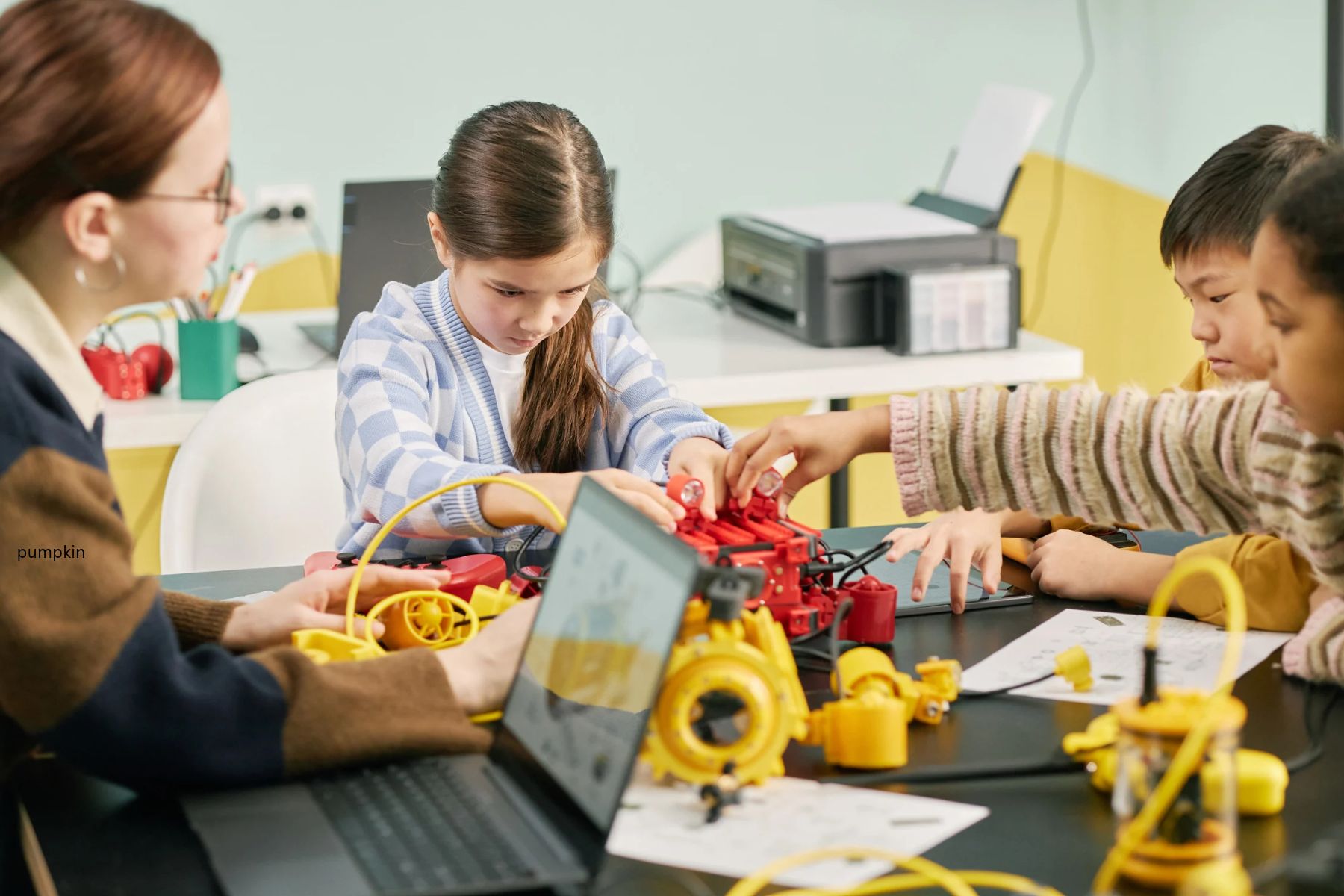
And STEM does not have to mean a classroom full of computers. At its best, it encourages children to ask questions, experiment, make mistakes, revise an idea, and discover that there is more than one way to solve a problem.
Whether your child is fascinated by robots, animation, architecture, science experiments, or simply figuring out how things work, there are several schools and programs throughout Wake County worth getting to know.
Public magnet schools: Specialized learning with a public-school foundation
Wake County Public School System offers a substantial magnet-school network, giving families the opportunity to explore specialized academic themes beyond their assigned neighborhood school. Magnet schools follow the North Carolina Standard Course of Study while incorporating a distinctive instructional focus. STEM-related themes include engineering, computer science, design, and hands-on scientific inquiry.
Admission is application-based, and placement is not guaranteed. Families should review current application dates, transportation arrangements, and eligibility requirements directly with the district.
Bugg Magnet Elementary School | Raleigh
Center for Design and Computer Sciences
For a child who loves computers, animation, digital creativity, or figuring out how technology works, Bugg Magnet Elementary deserves a close look.
Bugg's Center for Design and Computer Sciences brings together design thinking and computer science. Students are encouraged to design, program, and innovate as they work through real-world challenges. The school's approach includes computational thinking, coding, robotics, and the creation of digital products.
What makes this program particularly interesting is the emphasis on creating with technology rather than simply using it. Children learn to think through a problem, develop an idea, test it, and refine their work.
For a young student who is already interested in animation or digital storytelling, this is a school worth visiting and asking about. Families may want to learn how those interests are introduced in the early grades and what kinds of creative projects kindergarten students actually complete.
Explore: Bugg Magnet Elementary
Brentwood Magnet Elementary School | Raleigh
School of Engineering
Brentwood offers a more explicitly engineering-centered approach. Students learn to approach challenges as young engineers, using a process that involves asking questions, imagining possibilities, planning, creating, testing, and improving.
The school incorporates hands-on STEM learning and specialized makerspaces, giving students opportunities to build and experiment rather than simply read about engineering concepts.
This is an appealing option for children who love constructing things, taking objects apart, building with blocks or LEGO, and discovering how different materials and designs work. The engineering process also teaches patience and resilience: an idea does not have to work the first time to be a worthwhile idea.
Brentwood's focus is integrated into the school's identity, making it one of the more distinctive elementary engineering options in the county.
Explore: Brentwood Magnet Elementary
Kingswood Magnet Elementary School | Cary
Montessori and STEM
One of the most interesting options for families in Cary is Kingswood Magnet Elementary, which combines Montessori education with a STEM focus.
The Montessori approach emphasizes purposeful materials, independence, meaningful choices, and learning through exploration. Kingswood brings that philosophy together with STEM thinking and project-based learning.
This combination can be especially appealing for children who learn best by doing. Rather than relying exclusively on direct instruction, Montessori classrooms give children opportunities to explore concepts, work with materials, and develop independence at their own pace.
Kingswood's approach also recognizes that academic development is only one part of a child's education. The school emphasizes the whole child, including social and emotional growth.
For families who want a STEM environment but are not necessarily looking for a highly technology-centered classroom, Kingswood is an option worth exploring.
Explore: Kingswood Magnet Elementary
Wake Forest Magnet Elementary School | Wake Forest
iSTEM
For families willing to look beyond Cary and Apex, Wake Forest Magnet Elementary offers another dedicated STEM option.
The school's iSTEM theme emphasizes hands-on, student-centered learning. Students develop skills in inquiry, problem-solving, collaboration, science, technology, engineering, and mathematics.
The program is designed to connect learning with student interests and real-world questions. That can be a good fit for children who are naturally curious, enjoy experimenting, and like working through challenges with other students.
The location may be a consideration for families living in the western Triangle, but it is worth knowing about when comparing the broader Wake County magnet network.
Explore: Wake Forest Magnet Elementary
Conn Magnet Elementary School | Raleigh
Entrepreneurial Design
STEM is not limited to laboratories, coding, or engineering projects. Creativity, communication, collaboration, and the ability to turn an idea into something tangible are important parts of innovation, too.
Conn Magnet Elementary approaches learning through entrepreneurial design. Students are encouraged to think creatively, collaborate, and develop ideas that can make a difference in their communities. Its design process connects creative thinking with problem-solving and real-world learning.
For a child who is imaginative, inventive, and constantly coming up with new ideas, this is an interesting alternative to a more traditional STEM program.
Explore: Conn Magnet Elementary
Charter schools: Another path to STEM-focused learning
Charter schools are publicly funded schools that operate independently of the traditional district school structure. They can offer families another way to find a particular educational philosophy or academic emphasis.
The Triangle has several charter schools with science, mathematics, technology, or STEAM-oriented approaches.
Triangle Math and Science Academy | Cary
Science, Mathematics, and Technology
Triangle Math and Science Academy (TMSA) is a natural school to include in a conversation about STEM education in Cary. The school emphasizes science and mathematics as central parts of its academic approach, with an interest in preparing students for future study and careers in technical fields.
For families considering TMSA, I would look closely at how the school's STEM philosophy is implemented in the elementary grades. Ask about hands-on projects, science instruction, technology integration, engineering activities, and how students are encouraged to apply what they learn.
It is also worth asking how the school's approach evolves as children move from kindergarten into the upper elementary and middle-school years.
Explore: Triangle Math and Science Academy
Envision Science Academy | Wake Forest
STEAM and project-based learning
Envision Science Academy offers a STEAM-oriented educational environment, incorporating science, technology, engineering, arts, and mathematics.
The inclusion of the arts is important. Innovation often happens where disciplines overlap: a student might use mathematics to design a structure, technology to create a digital project, and artistic thinking to communicate an idea.
Envision is located in Wake Forest, so commute and location will matter for many families in the Cary and Apex areas. Still, it belongs on the list for parents looking for a school with a strong science and technology identity.
Explore: Envision Science Academy
Don't overlook neighborhood schools
A dedicated STEM magnet or charter school is not the only way to give a child a strong foundation in science and technology.
Traditional neighborhood schools teach the same core academic standards and can offer excellent opportunities for children to explore science, mathematics, creativity, and problem-solving. The experience can vary by school, classroom, teacher, enrichment opportunities, and the way hands-on learning is incorporated into the curriculum.
For families considering Cary and Apex, I would not overlook the neighborhood-school conversation.
Weatherstone Elementary School | Cary
Weatherstone is particularly interesting because of its established STEM identity. The school describes its approach as hands-on, real-world learning designed to develop creativity, collaboration, critical thinking, and communication.
It has also received recognition through North Carolina's STEM school recognition program and currently highlights STEM experiences as part of its academic focus.
Weatherstone is a good example of why it is worth looking beyond a school's label. Families may find a meaningful STEM environment at a neighborhood school, without necessarily needing to pursue a magnet or charter placement.
When touring, ask how STEM learning is introduced in kindergarten and how students progress toward more complex projects in later grades.
Explore: Weatherstone Elementary
Other Cary and Apex neighborhood schools
Families may also want to investigate their assigned schools in Cary and Apex, including Davis Drive, Mills Park, Carpenter, Highcroft Drive, Penny Road, Reedy Creek, Laurel Park, Olive Chapel, and other area elementary schools.
I would not automatically classify these schools as dedicated STEM programs. Rather, they are worth evaluating as part of a broader school search. Ask about science instruction, technology resources, enrichment, hands-on projects, clubs, and opportunities for students to explore interests beyond the standard classroom curriculum.
A strong teacher, a supportive school culture, and an engaging classroom can make an enormous difference in a young child's experience.
And remember: Wake County base-school assignments are determined by a property's address. A school that looks close on a map is not necessarily the assigned school. Families should verify assignments using the district's address-based school lookup before making a housing decision.
STEM beyond the school day: Enrichment around the Triangle
A child's interests do not have to be limited to the school curriculum. One of the advantages of living in the Triangle is the range of enrichment opportunities available outside the classroom.
For some children, an after-school program, weekend class, or summer camp can be a wonderful way to explore an interest without making it the central focus of their school day.
A few local programs worth investigating include:
The ART of S.T.E.M. | Apex
This program brings together visual and performing arts with science, technology, engineering, and mathematics. It is an especially interesting concept for children who enjoy both creative expression and hands-on exploration.
The combination matters. Art and technology are not opposing interests. Animation, game design, architecture, digital illustration, and product design all rely on creative thinking as well as technical skills.
For younger children, the emphasis on experimentation, making, and creative confidence can be a particularly nice introduction to STEM.
Code Ninjas | Cary
For children who are interested in video games and computers, Code Ninjas offers a more direct introduction to coding and technology. Programs may include coding activities, game development, and robotics-related experiences.
Parents should confirm current age requirements and beginner-level offerings for younger students. The best introduction to coding at this age should feel playful and creative, not like another academic assignment.
Engineering For Kids of the Triangle | Morrisville
Engineering For Kids offers hands-on opportunities to explore engineering, robotics, design, and technology through classes and camps.
This is worth considering for children who like to build, experiment, and see how things work. Ask about the current age ranges and the kinds of projects offered for younger elementary students.
Zebra Robotics | Cary
Zebra Robotics offers programs in robotics, coding and AI, and technology and engineering, with published programming primarily serving students in grades 1–12.
It may be more appropriate as a child gets a little older, but it is a useful local resource for families interested in developing a longer-term interest in robotics and technology.
NC STEM Academy | Cary
For families looking for hands-on science enrichment, NC STEM Academy offers another local resource. Its programming includes experiment-based science learning, camps, and opportunities for students to explore scientific topics in greater depth.
This is a good option to investigate for children who are fascinated by experiments, science questions, and discovering how the world works.
What should parents look for in a STEM kindergarten?
When a child is just beginning school, I would be careful not to put too much emphasis on how advanced a program sounds.
At five or six years old, a strong STEM experience should be developmentally appropriate. Children need time to play, explore, build, imagine, ask questions, and work with their hands. They do not need to be pushed into formal programming or advanced technical instruction before they are ready.
When visiting a school, I would look for a few things:
Hands-on learning: Are children building, testing, experimenting, and exploring, or primarily watching and listening?
Creative problem-solving: Are students encouraged to develop their own ideas and try different approaches?
Age-appropriate technology: Is technology used as a tool for creating and learning, rather than simply consuming content?
Room for different interests: Can a child explore science, art, design, storytelling, and construction?
Collaboration: Do students have opportunities to work together, share ideas, and learn from one another?
A supportive learning environment: How does the school respond when a child needs additional support, a different approach, or more time to understand a concept?
For a child interested in animation, for example, I would ask whether students have opportunities to explore visual storytelling, digital drawing, simple animation, coding, or creative design as they move through the elementary grades.
For a child who loves building, I would ask about engineering challenges, robotics, makerspaces, and project-based learning.
The goal is not to turn kindergarten into a technical training program. It is to preserve that natural curiosity and give it room to grow.
Finding the right school—and the right community
One of the things I appreciate about the Triangle is that families have choices. There are schools with dedicated engineering and computer science themes, Montessori environments that incorporate STEM, charter schools with science and mathematics at the center of their curriculum, and neighborhood schools where children can build a strong academic foundation.
There is no single best option for every child.
A family might decide that a specialized magnet program is exactly what they are looking for. Another may prefer the flexibility of a neighborhood school and supplement it with robotics, art, or coding programs. And for some children, the best fit may be a school that balances academic challenge with a more creative, hands-on approach to learning.
As you compare schools, consider the full picture: the educational philosophy, the classroom environment, the commute, extracurricular opportunities, and the community where your family will spend its time.
If you're considering a move to Cary, Apex, or another part of the Triangle, it is worth looking at school options and neighborhoods together. Base-school assignments, magnet access, transportation, and everyday drive times can all influence what makes sense for a family.
The best starting point is a school visit. Ask questions, see how children are learning, and pay attention to whether the environment feels like a place where your child could be curious, challenged, and happy.
Because the real objective of STEM education is not simply to teach children how to use technology. It is to help them become the people who will imagine what comes next.
School programs, admissions criteria, transportation, and enrichment schedules can change. Families should confirm current details directly with each school or program before making decisions.
Check out this article next